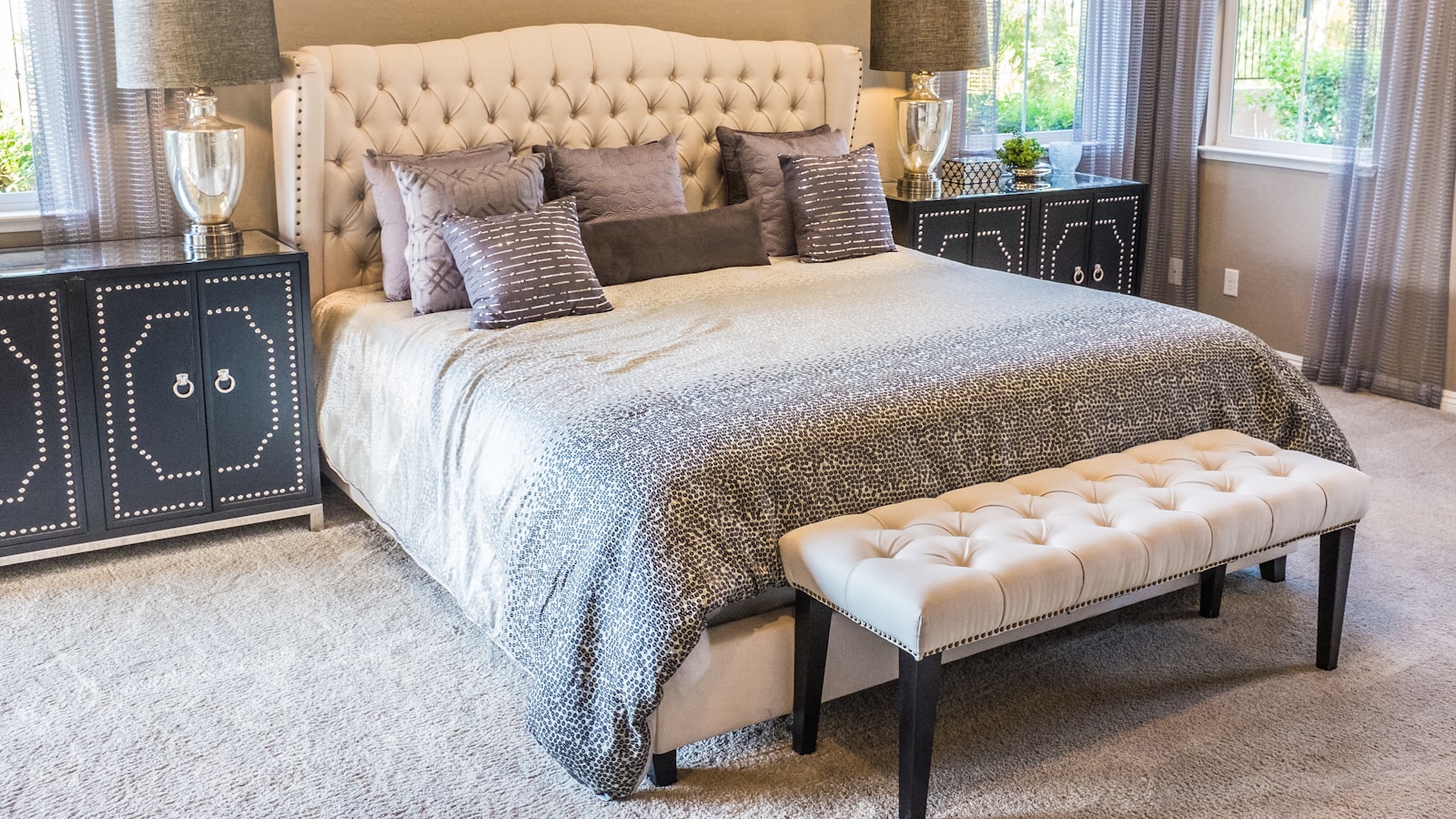
The bedroom is the room with the most synthetic material per square metre in most flats. Mattresses, pillows, duvets, sheets, throws, curtains: an enormous amount of polyester, foam, and flame-retardant treatment, all pressed against the human face for eight hours a night.
A sustainable bedroom is not a hair-shirt exercise. It is a set of better defaults, applied over time as items wear out, that produce a room that is healthier to sleep in and lower-impact to maintain.
The mattress decision
A mattress is the single most significant bedroom purchase from a sustainability angle. It is bulky, hard to recycle, and dominates the room’s embedded carbon. Most cheap mattresses are polyurethane foam, which is energy-intensive to produce and very difficult to dispose of responsibly.
Better options, in rough order: a natural-latex mattress (rubber from latex-tree sap, biodegradable, durable for 15+ years), an organic-cotton-and-wool mattress (very long-lasting, naturally flame-retardant without chemicals, expensive), or a pocket-spring mattress with a wool top (easier to recycle than foam, mid-priced). Avoid all-foam mattresses where possible.
Whichever you choose, buy the best mattress you can comfortably afford and keep it for at least 10 years. A mattress kept twice as long has half the lifetime environmental cost.
Bedlinen, edited
The right number of bedlinen sets is two per bed, not seven. Two sets allows one to be on the bed while the other is in the wash, rotating weekly. Anything beyond two becomes a storage tax and rarely gets used.
Choose organic cotton, linen, or a cotton-linen blend. Avoid pure polyester or microfibre sheets, they trap heat, shed microplastics, and feel synthetic against the skin. Look for OEKO-TEX or GOTS certification, both of which restrict the chemicals used in manufacturing.
Higher thread counts (300+) are nice but not necessary; many of the loveliest sheets are simple percale weaves at 200, 280 thread count. Linen, often dismissed as wrinkled, ages into a beautifully soft fabric over years and uses less water and pesticide in cultivation than cotton.
Pillows and duvets
Most cheap pillows and duvets are polyester-fibre filled. They are inexpensive but rarely last more than two years before flattening, and they cannot be effectively recycled. Better fill options include responsibly sourced down (look for the Responsible Down Standard), wool (naturally regulating temperature, machine-washable wool fills now exist), or kapok (a vegan, plant-based fill from the kapok tree).
Buy one of each, well, rather than three of any cheaply. Replace pillows roughly every five years; replace duvets every eight to ten.
Curtains and soft furnishings
Heavy curtains are one of the most underrated bedroom interventions, for both sustainability and sleep quality. A well-lined curtain in linen or organic cotton significantly reduces summer heat gain, retains winter warmth, and improves the room’s thermal regulation. The energy savings can be measurable over a year, particularly for west or south-facing rooms.
Look for curtains with cotton or wool inner linings rather than polyester. Avoid PVC-coated blackout fabrics, both for environmental reasons and because they often have a chemical smell that persists for months.
Mattress protection and care
A waterproof mattress protector extends mattress life dramatically, but most are plastic-laminated and uncomfortable. The better option is a wool or cotton fitted topper, which absorbs moisture, regulates temperature, and protects the mattress without the plastic film.
Rotate the mattress every six months (turn it end-to-end if it is one-sided, or flip it if it is double-sided). Vacuum it with the upholstery tool every quarter to remove dust mites. These two habits double mattress lifespan.
The wood you sleep on
Bed frames are usually the longest-lived bedroom item. Buying a well-made wooden frame from FSC-certified timber, second-hand, or from a small workshop is a one-time decision that can outlast three mattresses. Avoid particleboard or MDF frames, they off-gas, fail at joints within a few years, and cannot be repaired.
Iron or steel frames are an equally good choice if you prefer the look, and they are infinitely recyclable. The visible nail in the design coffin is the cheap flatpack frame; it is genuinely false economy.
Cleaning the air, gently
The bedroom is the room where indoor air quality matters most, because you breathe it eight hours a night. The interventions are simple. Open the windows for fifteen minutes every morning, even in winter, to flush stale air. Vacuum the floor weekly with a HEPA-filter vacuum. Avoid plug-in air fresheners and synthetic candles, which add volatile compounds to the air. A small dehumidifier in damp flats can dramatically improve sleep quality.
Houseplants do less for air quality than was once claimed, but a single calming plant (snake plant, peace lily, keep away from pets) makes the room feel alive without adding pollutants.
Related: Low-Impact Laundry for People Without a Garden to Hang Things On
Lighting that respects sleep
Bedroom lighting affects both sustainability and sleep quality. A bedside lamp with a warm-tone LED bulb (2700K or lower) uses minimal energy and signals bedtime to the brain better than the harsh overhead light. A single dimmable overhead with a 60, 80 lumen reading bulb in the bedside lamp is the high-efficiency, low-impact default.
Avoid LED strips that change colour through an app for sleep environments. They use more standby power than expected and the wireless control adds complexity for no real benefit.
Related: Reducing Plastic in a Renter’s Kitchen Without Going to War with It
The room, after a year
A genuinely sustainable bedroom, built up over a year as items naturally need replacing, looks almost identical to a typical bedroom. The difference is in the materials: natural fibres against the skin, a single durable mattress, a small set of high-quality linens, no plastic curtains, no synthetic-smelling air. The room sleeps better, lasts longer between purchases, and has a fraction of the lifetime environmental cost of a wholly synthetic equivalent.
Related: Eco Cooking in a Small Kitchen, Without Buying a Second Kitchen
A note on imperfection
Anyone who tries to live more sustainably for any length of time will encounter the same realisation: perfection is impossible, and trying for it produces burnout faster than it produces results. The articles, podcasts, and social media accounts that promise zero-waste, fully-circular, completely-aligned-with-values living are almost always either dishonest or describing a privileged minority who can afford the time and money required to even approximate it.
The realistic version of sustainable practice tolerates a generous proportion of imperfect choices. Some weeks the shopping is a delivery order rather than a careful bike trip to the greengrocer. Some Saturdays involve a long drive to see family. Some months involve a flight that genuinely could not be avoided. The pattern across years is what shifts the environmental footprint, not the perfect adherence to any specific week. A household that is genuinely 60 percent of the way to a low-impact baseline is dramatically better than one trying to be 100 percent for six weeks and then quitting.
At a glance
| Section | What the article covers |
|---|---|
| The mattress decision | A mattress is the single most significant bedroom purchase from a sustainability angle. |
| Bedlinen, edited | The right number of bedlinen sets is two per bed, not seven. |
| Pillows and duvets | Most cheap pillows and duvets are polyester-fibre filled. |
| Curtains and soft furnishings | Heavy curtains are one of the most underrated bedroom interventions, for both sustainability and sleep quality. |
| Mattress protection and care | A waterproof mattress protector extends mattress life dramatically, but most are plastic-laminated and uncomfortable. |
Sources and further reading
Frequently asked questions
Usually yes, if you keep them. Natural-latex and wool mattresses typically last 15, 20 years versus 7, 10 for foam. The per-year cost is often lower despite the higher upfront price.
Look for specific certifications (GOTS, OEKO-TEX 100, Fairtrade). Words like "natural," "eco-friendly," or "sustainable" without certification are marketing.
Many city councils now offer mattress recycling collection for a small fee. The mattress is broken down by component (springs, foam, fabric) and recycled. Avoid skip disposal, most mattresses can be processed properly.
The research on this is overstated. A few plants are neutral. Many plants in a small room can slightly raise humidity, which may be helpful in dry winters but unhelpful in damp flats.