
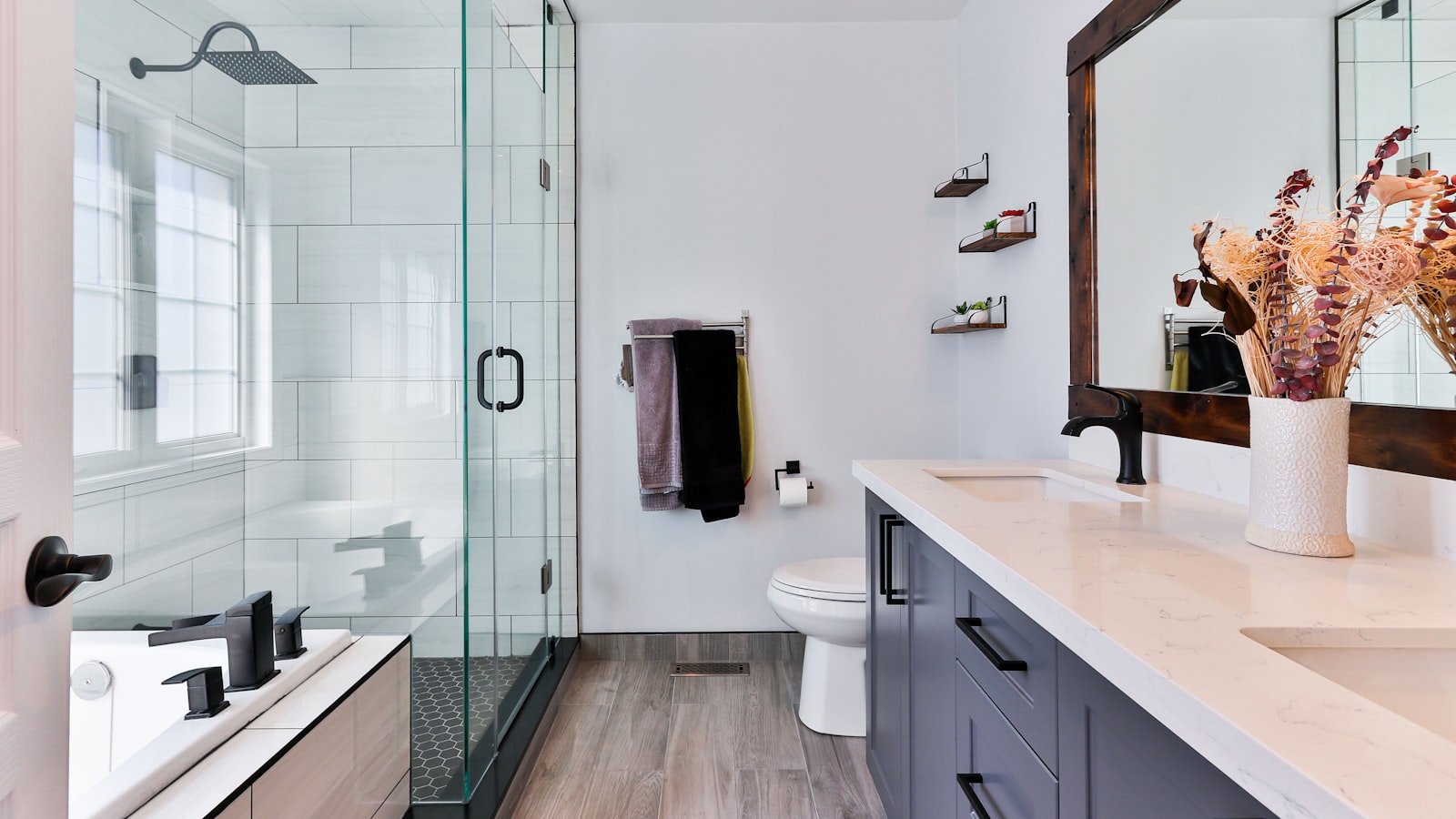
The bathroom is the highest-water-use room in most flats. A typical city bathroom accounts for roughly half of household water consumption, mostly from showers and toilet flushes. Most of the popular “save water” advice is either correct but trivial (turn off the tap while brushing) or impressive-sounding but irrelevant for renters (replace your low-flow toilet).
Here is a clearer view of which water-saving moves actually deliver in a rented city bathroom, ranked by impact.
The biggest lever: shower duration
The single most impactful change in any rented bathroom is reducing shower length. A standard showerhead uses 9, 15 litres per minute. A ten-minute shower is therefore 90, 150 litres of water heated to roughly 40 degrees Celsius, both a large volume and a large energy cost.
Cutting a typical shower from ten minutes to five saves around 70 litres per shower, every day, for the rest of the time you live in the flat. Across a year, that is roughly 25,000 litres of water and a significant chunk of heating gas or electricity.
The trick is making the reduction effortless. A small waterproof timer stuck to the shower tile, set to four minutes for the wash and one minute for the rinse, removes the willpower component. After a week, the new shower length feels normal.
The second lever: low-flow inserts
You probably cannot replace the showerhead in a rental flat, but you can usually replace the small flow restrictor inside it, or screw a small low-flow insert into the existing fitting. Costs around ten pounds. Takes five minutes with an adjustable spanner. Reduces flow from roughly 12 litres per minute to 7, 8 without changing the shower’s feel significantly.
The same applies to bathroom taps. Most modern taps have a small aerator at the tip that unscrews. A low-flow aerator screws back into the same threading and reduces tap flow from around 8 litres per minute to 4. The originals go into a labelled bag in a drawer so you can reinstall them when you move out.
Combined, these two small replacements save around 20, 30 percent of the bathroom’s water use, cost less than fifteen pounds, and are fully reversible.
The toilet, addressed honestly
You cannot replace the toilet in a rented flat. You can, in some cases, install a “displacement device” in the cistern, a sealed bag or bottle filled with water that takes up space and means each flush uses slightly less. Modern dual-flush toilets already use minimal water, so this is mainly relevant for older single-flush toilets.
The more useful intervention: report any toilet leak immediately. A silently leaking toilet (the kind where water trickles into the bowl between flushes) can waste 100, 200 litres per day. This is your landlord’s responsibility to fix; flag it the moment you notice.
The tap habits that matter
“Turn off the tap while brushing teeth” is a famous water-saving tip, and it is genuinely useful, roughly 6 litres saved per brush, twice a day, for 4,400 litres per year per person. Worth doing.
The less-discussed equivalent: shave with a basin of water rather than running tap, wet hands quickly and turn off the tap to soap up, run the tap only briefly to rinse vegetables rather than continuously. Each of these is a small habit; together they save another few thousand litres per year per person.
The dishwasher vs. hand-wash question
A modern dishwasher run full on the eco cycle uses around 10 litres of water for a full load. The same load washed by hand under a running tap uses 30, 80 litres, depending on how careful the washer is. Even hand-washing in a single basin of water uses around 15, 20 litres.
If your flat has a dishwasher, use it. Run it only when full. Choose the eco cycle. Skip pre-rinsing, modern detergent enzymes work better on dried-on food than pre-rinsed plates anyway. This is one of the rare cases where the appliance is significantly more sustainable than the manual alternative.
The grey-water question
Reusing household water for non-drinking purposes (toilet flushing, plant watering) is technically possible but rarely practical in a rented flat. The plumbing changes are landlord-territory. The realistic version for renters: keep a small bucket in the shower to catch the water that runs while the shower heats up, then use that water for plants or toilet flushing. This is a small win, but it is the only structural grey-water option available without altering plumbing.
Heating water is also using water
Hot water has a carbon cost on top of its water cost. Roughly 80 percent of the energy to provide hot water is in the heating, not the pumping. So a hot-water saving is doubly valuable: it cuts both the water bill and the energy bill.
The practical implications: use cold water when you can (rinsing dishes, washing hands, brushing teeth). Insulate hot water pipes if they run along an unheated wall (a renter-friendly DIY job with foam pipe sleeves). Set the boiler to 55, 60 degrees rather than 70, hot enough to prevent legionella, cool enough to use significantly less gas.
Related: Eco Cooking in a Small Kitchen, Without Buying a Second Kitchen
The leak audit
Once a year, spend an hour doing a leak audit. Listen carefully near the toilet base for trickle sounds. Touch around tap bases for damp. Check the pipework under the sink for moisture. Watch the water meter (if accessible) for 30 minutes with no water use; the needle should not move.
A typical city flat has a dripping tap, a slowly leaking toilet, or both. Each costs a small amount of water continuously. Fixing them takes a phone call to the landlord and ten minutes of plumber time. The cumulative annual saving from fixing two slow leaks can be 30,000+ litres.
Related: Reducing Plastic in a Renter’s Kitchen Without Going to War with It
The single takeaway
If you only do one thing: install a shower timer. The reduction in shower duration is the single largest water and energy saving available to a renter in a normal flat. Everything else in this article is meaningful but additive. The shower timer is foundational.
Related: Low-Impact Laundry for People Without a Garden to Hang Things On
A note on imperfection
Anyone who tries to live more sustainably for any length of time will encounter the same realisation: perfection is impossible, and trying for it produces burnout faster than it produces results. The articles, podcasts, and social media accounts that promise zero-waste, fully-circular, completely-aligned-with-values living are almost always either dishonest or describing a privileged minority who can afford the time and money required to even approximate it.
The realistic version of sustainable practice tolerates a generous proportion of imperfect choices. Some weeks the shopping is a delivery order rather than a careful bike trip to the greengrocer. Some Saturdays involve a long drive to see family. Some months involve a flight that genuinely could not be avoided. The pattern across years is what shifts the environmental footprint, not the perfect adherence to any specific week. A household that is genuinely 60 percent of the way to a low-impact baseline is dramatically better than one trying to be 100 percent for six weeks and then quitting.
At a glance
| Section | What the article covers |
|---|---|
| The biggest lever: shower duration | The single most impactful change in any rented bathroom is reducing shower length. |
| The second lever: low-flow inserts | You probably cannot replace the showerhead in a rental flat, but you can usually replace the small flow restrictor inside it, or screw a small low-flow inser… |
| The toilet, addressed honestly | You cannot replace the toilet in a rented flat. |
| The tap habits that matter | "Turn off the tap while brushing teeth" is a famous water-saving tip, and it is genuinely useful, roughly 6 litres saved per brush, twice a day, for 4,400 li… |
| The dishwasher vs. hand-wash question | A modern dishwasher run full on the eco cycle uses around 10 litres of water for a full load. |
Sources and further reading
Frequently asked questions
Modern low-flow inserts use aeration and pulsed flow to maintain perceived pressure. The first day feels slightly different; by week two most people cannot tell. The cheapest models can feel weaker, so spend the extra £5 on a pressure-compensating type.
Document the leak (photo and date), email the landlord with the request, and follow your local tenancy advice service for next steps. In most jurisdictions, a leak that wastes utility-billed water is the landlord's responsibility to repair.
Yes. A full bath uses around 80, 120 litres; a five-minute shower at low flow uses around 40 litres. A long hot bath is the highest-water-use single act in a typical bathroom week.
Around 6 litres per brush, or 4,400 litres per person per year. It is a small habit with a meaningfully large cumulative effect.